Story/Vocation of Place: The Phoenix Basin
(AI image by Matthew Salenger)
Story/Vocation of Place: The Phoenix Basin
Matthew Salenger
Phoenix is not simply a hot city in the desert. It is a Sonoran basin civilization: a vast inhabited plain made possible by Indigenous water knowledge and labor, then reshaped by engineering. The roots of the place matter. The Akimel O’odham are “River People,” and the basin bears that imprint. Ancient canals in the Salt River Valley show that the city rose atop an earlier water-shaped world.
That history suggests something deeper than infrastructure. Canals of that scale required sustained cooperation: shared timing, labor, maintenance, repair, and agreement about how the system would be kept alive. Phoenix’s original civic act was not road building or speculation. It was collective water choreography. The basin’s oldest lesson is that survival here depends on coordinating around common systems over long periods of time. That may be the truest cultural foundation Phoenix has.
The land reinforces that lesson. Phoenix sits low in the Sonoran Basin, where rainfall arrives in pulses and heat persists as a governing condition. This is not a place of steady abundance. Brief storms, long dry stretches, and relentless summer exposure must be translated into usable forms of life. The basin’s intelligence has always been about timing and transformation: catch the pulse, slow it, spread it, sink it, and turn it into future fertility, comfort, and survival.
That is why Phoenix’s ‘vocation’ may be larger than “dealing with heat” or “finding more water.” It may be a proving ground for desert metropolitan life. Phoenix is large enough to matter, remote enough to experiment, and pressured enough to invent. Arizona has repeatedly generated practical ideas that the outside world notices late, from Tucson’s stormwater harvesting culture to Phoenix’s reuse and aquifer recharge systems. These are working examples of a basin learning how to close loops.
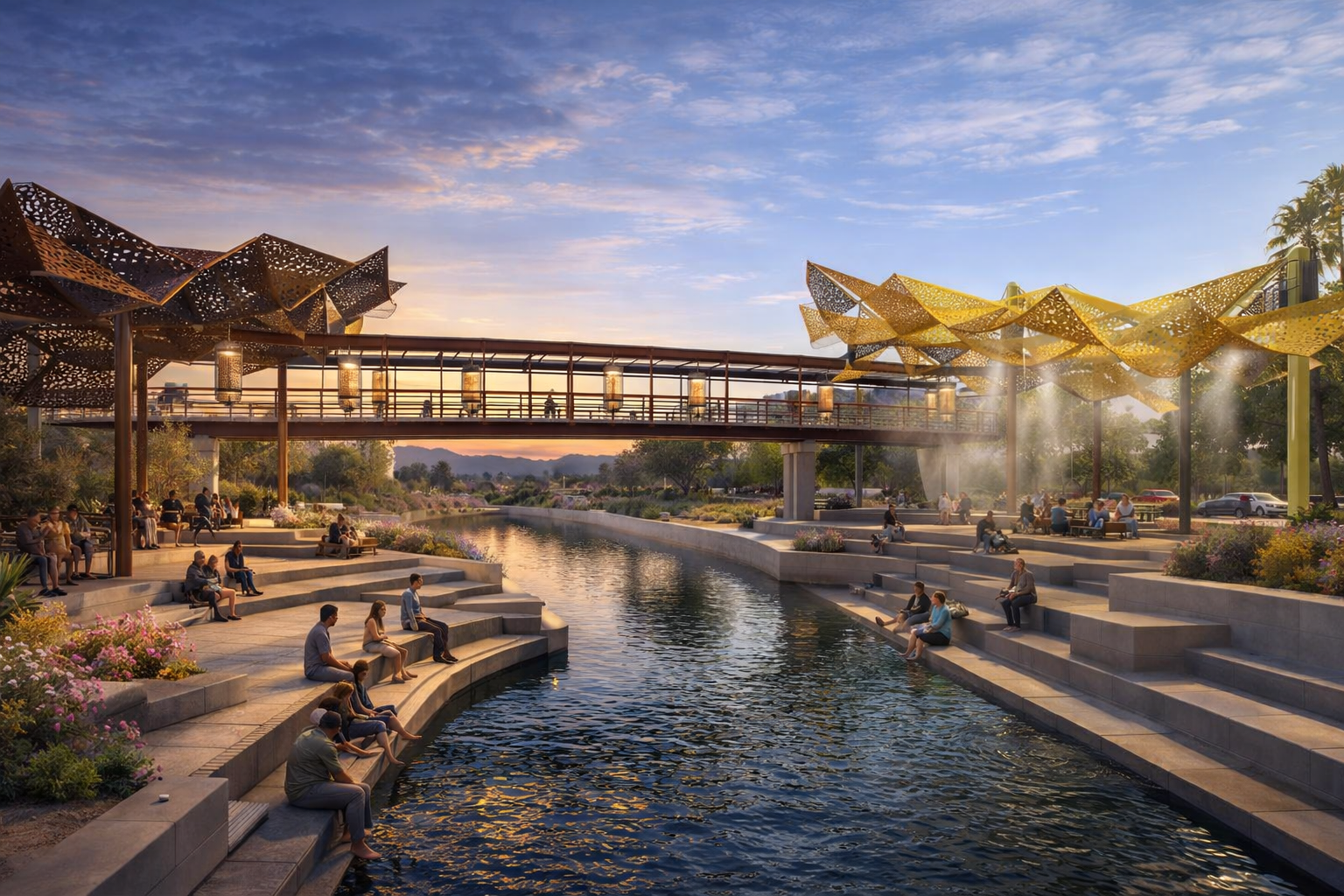
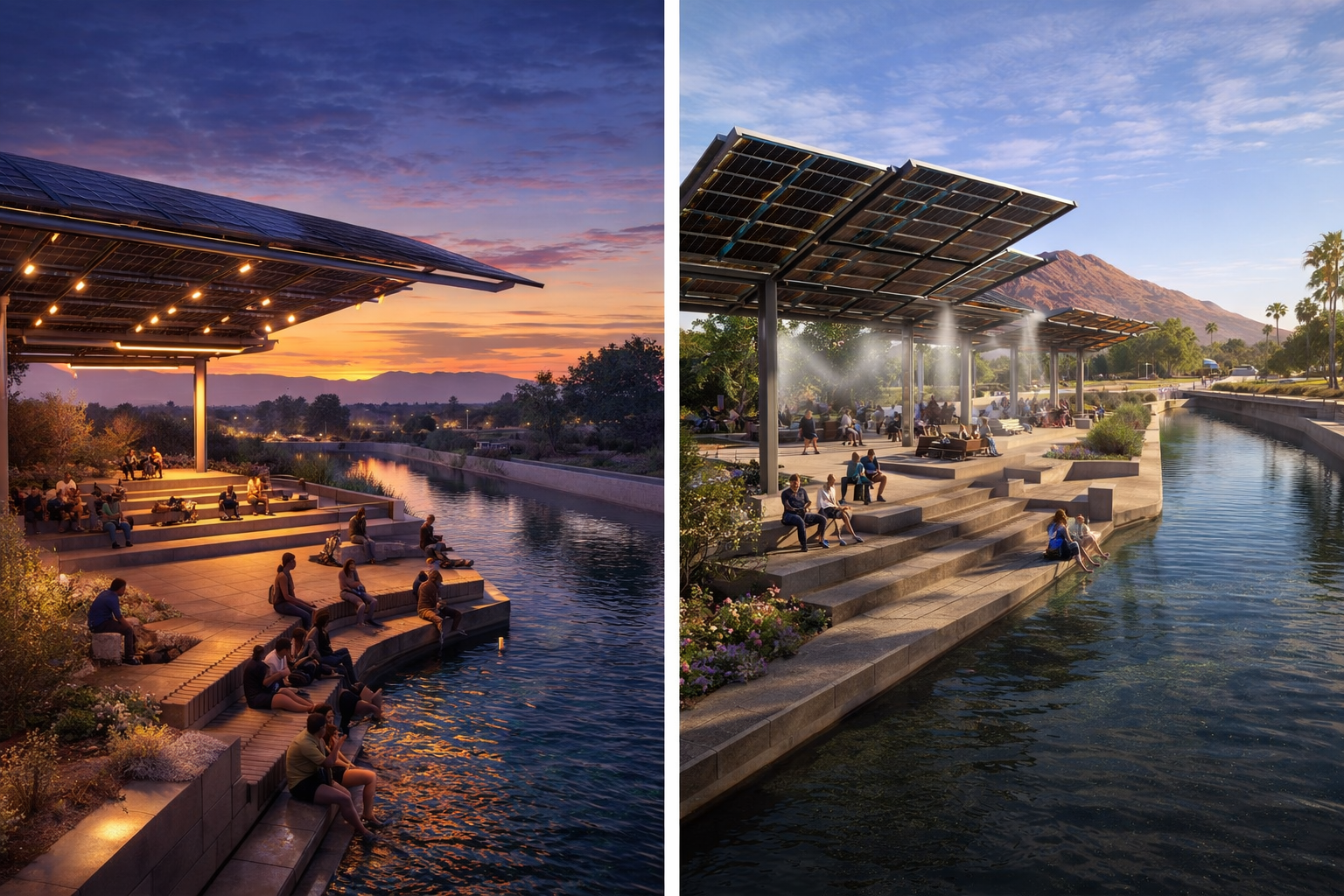
If that is true, Phoenix should not aim merely to survive. It should aim to turn desert limits into visible civic culture. The question is not only how to engineer water and heat, but how to let those realities shape public life in a way that builds community. The ancient canal systems likely required recurring forms of gathering, coordination, obligation, and shared identity. A contemporary version could include neighborhood-scale water harvesting, shaded public rooms, canal-edge paths, wash corridors, and civic landscapes that invite participation in basin life. The infrastructure should not remain hidden. It should teach, gather, and help create a culture rooted in this place rather than generic sunbelt convenience.
Phoenix is not one culture. It is a metropolitan field with multiple ways of belonging: centers where memory and civic identity accumulate, desert-edge zones where ecological limits are still felt, and the enormous middle—spread out, repetitive, highly functional, but often weak in place attachment. So the next story of place for Phoenix cannot be only technical. It has to ask how water, shade, and public realm can produce more local identity where attachment is weakest. In Phoenix, climate adaptation and culture-making may need to become the same project.
There is also a harder second story underneath all of this. Phoenix’s modern water regime depends heavily on imported supply, and Colorado River shortages are already testing that system. The basin may be approaching a period in which its talent for hydraulic coordination is tested under harsher terms. Phoenix may be forced to become more inventive not because it wants to lead, but because shortage will leave it no choice.
So the vocation of Phoenix may be this: to become the Sonoran basin’s workshop for cooperative urban life under desert conditions. Not a spectacle. Not a fantasy oasis. A place that learns, tests, repairs, harvests, cools, reuses, recharges, and turns those acts into stronger public culture. Water and heat are not the vocation by themselves; they are the pressures that reveal it. The deeper vocation is collective intelligence applied to the problem of how millions of people might live meaningfully in a hot basin without pretending they are somewhere else.
(AI image by Matthew Salenger)
Bibliography
Story/Vocation of Place: The Phoenix Basin
Foundational history and water systems
Gregory, David A. The Hohokam: Ancient People of the Desert. Santa Fe, NM: School for Advanced Research Press, 2001.
Haury, Emil W. The Hohokam: Desert Farmers and Craftsmen. Tucson, AZ: University of Arizona Press, 1976.
Howard, Jerry R. Salt River Valley Irrigation and the Development of Phoenix. Phoenix, AZ: Salt River Project, 1993.
Reisner, Marc. Cadillac Desert: The American West and Its Disappearing Water. New York: Penguin Books, 1986.
Worster, Donald. Rivers of Empire: Water, Aridity, and the Growth of the American West. New York: Oxford University Press, 1985.
Indigenous knowledge and desert lifeways
Nabhan, Gary Paul. The Desert Smells Like Rain: A Naturalist in Papago Indian Country. Tucson, AZ: University of Arizona Press, 1982.
Sheridan, Thomas E. Arizona: A History. Tucson, AZ: University of Arizona Press, 2012.
Fontana, Bernard L. Of Earth and Little Rain: The Papago Indians. Tucson, AZ: University of Arizona Press, 1989.
Sonoran Desert ecology and climate
Phillips, Steven J., and Patricia Wentworth Comus, eds. A Natural History of the Sonoran Desert. Tucson, AZ: Arizona-Sonora Desert Museum Press, 2000.
Turner, Raymond M., et al. Sonoran Desert Plants: An Ecological Atlas. Tucson, AZ: University of Arizona Press, 1995.
Hereford, Richard, et al. Precipitation History of the Colorado Plateau Region, 1900–2000. U.S. Geological Survey, 2002.
Phoenix, infrastructure, and metropolitan growth
Gammage, Grady. Phoenix in Perspective: Reflections on Developing the Desert. Tempe, AZ: Herberger Center for Design Excellence, Arizona State University, 1999.
Gammage, Grady. The Future of the Suburban City: Lessons from Sustaining Phoenix. Washington, DC: Island Press, 2016.
Luckingham, Bradford. Phoenix: The History of a Southwestern Metropolis. Tucson, AZ: University of Arizona Press, 1989.
Ross, Andrew. Bird on Fire: Lessons from the World’s Least Sustainable City. New York: Oxford University Press, 2011.
Water management, reuse, and contemporary systems
Megdal, Sharon B., et al. “Water Management in Arizona: Past, Present, and Future.” Arizona Water Series, University of Arizona Water Resources Research Center, various publications.
Central Arizona Project (CAP). Colorado River Water Supply and Arizona’s Future. Phoenix, AZ.
Salt River Project (SRP). Water Operations and Reservoir System Overview. Phoenix, AZ.
Arizona Department of Water Resources (ADWR). Arizona Water Atlas. Phoenix, AZ, 2009.
Governance, cooperation, and the commons
Ostrom, Elinor. Governing the Commons: The Evolution of Institutions for Collective Action. Cambridge: Cambridge University Press, 1990.
Scott, James C. Seeing Like a State: How Certain Schemes to Improve the Human Condition Have Failed. New Haven, CT: Yale University Press, 1998.
Regenerative and systems thinking context
Sanford, Carol. The Regenerative Life: Transform Any Organization, Our Society, and Your Destiny. Boston, MA: Nicholas Brealey, 2017.
Mang, Pamela, and Bill Reed. “Designing from Place: A Regenerative Framework.” Building Research & Information, 2012.
Goodwin, Neva. “The Five Capitals Model.” Boston University, Global Development and Environment Institute.
Bibliography
Story/Vocation of Place: The Phoenix Basin
Foundational history and water systems
Gregory, David A. The Hohokam: Ancient People of the Desert. Santa Fe, NM: School for Advanced Research Press, 2001.
Haury, Emil W. The Hohokam: Desert Farmers and Craftsmen. Tucson, AZ: University of Arizona Press, 1976.
Howard, Jerry R. Salt River Valley Irrigation and the Development of Phoenix. Phoenix, AZ: Salt River Project, 1993.
Reisner, Marc. Cadillac Desert: The American West and Its Disappearing Water. New York: Penguin Books, 1986.
Worster, Donald. Rivers of Empire: Water, Aridity, and the Growth of the American West. New York: Oxford University Press, 1985.
Indigenous knowledge and desert lifeways
Nabhan, Gary Paul. The Desert Smells Like Rain: A Naturalist in Papago Indian Country. Tucson, AZ: University of Arizona Press, 1982.
Sheridan, Thomas E. Arizona: A History. Tucson, AZ: University of Arizona Press, 2012.
Fontana, Bernard L. Of Earth and Little Rain: The Papago Indians. Tucson, AZ: University of Arizona Press, 1989.
Sonoran Desert ecology and climate
Phillips, Steven J., and Patricia Wentworth Comus, eds. A Natural History of the Sonoran Desert. Tucson, AZ: Arizona-Sonora Desert Museum Press, 2000.
Turner, Raymond M., et al. Sonoran Desert Plants: An Ecological Atlas. Tucson, AZ: University of Arizona Press, 1995.
Hereford, Richard, et al. Precipitation History of the Colorado Plateau Region, 1900–2000. U.S. Geological Survey, 2002.
Phoenix, infrastructure, and metropolitan growth
Gammage, Grady. Phoenix in Perspective: Reflections on Developing the Desert. Tempe, AZ: Herberger Center for Design Excellence, Arizona State University, 1999.
Gammage, Grady. The Future of the Suburban City: Lessons from Sustaining Phoenix. Washington, DC: Island Press, 2016.
Luckingham, Bradford. Phoenix: The History of a Southwestern Metropolis. Tucson, AZ: University of Arizona Press, 1989.
Ross, Andrew. Bird on Fire: Lessons from the World’s Least Sustainable City. New York: Oxford University Press, 2011.
Water management, reuse, and contemporary systems
Megdal, Sharon B., et al. “Water Management in Arizona: Past, Present, and Future.” Arizona Water Series, University of Arizona Water Resources Research Center, various publications.
Central Arizona Project (CAP). Colorado River Water Supply and Arizona’s Future. Phoenix, AZ.
Salt River Project (SRP). Water Operations and Reservoir System Overview. Phoenix, AZ.
Arizona Department of Water Resources (ADWR). Arizona Water Atlas. Phoenix, AZ, 2009.
Governance, cooperation, and the commons
Ostrom, Elinor. Governing the Commons: The Evolution of Institutions for Collective Action. Cambridge: Cambridge University Press, 1990.
Scott, James C. Seeing Like a State: How Certain Schemes to Improve the Human Condition Have Failed. New Haven, CT: Yale University Press, 1998.
Regenerative and systems thinking context
Sanford, Carol. The Regenerative Life: Transform Any Organization, Our Society, and Your Destiny. Boston, MA: Nicholas Brealey, 2017.
Mang, Pamela, and Bill Reed. “Designing from Place: A Regenerative Framework.” Building Research & Information, 2012.