The Efficiency Trap
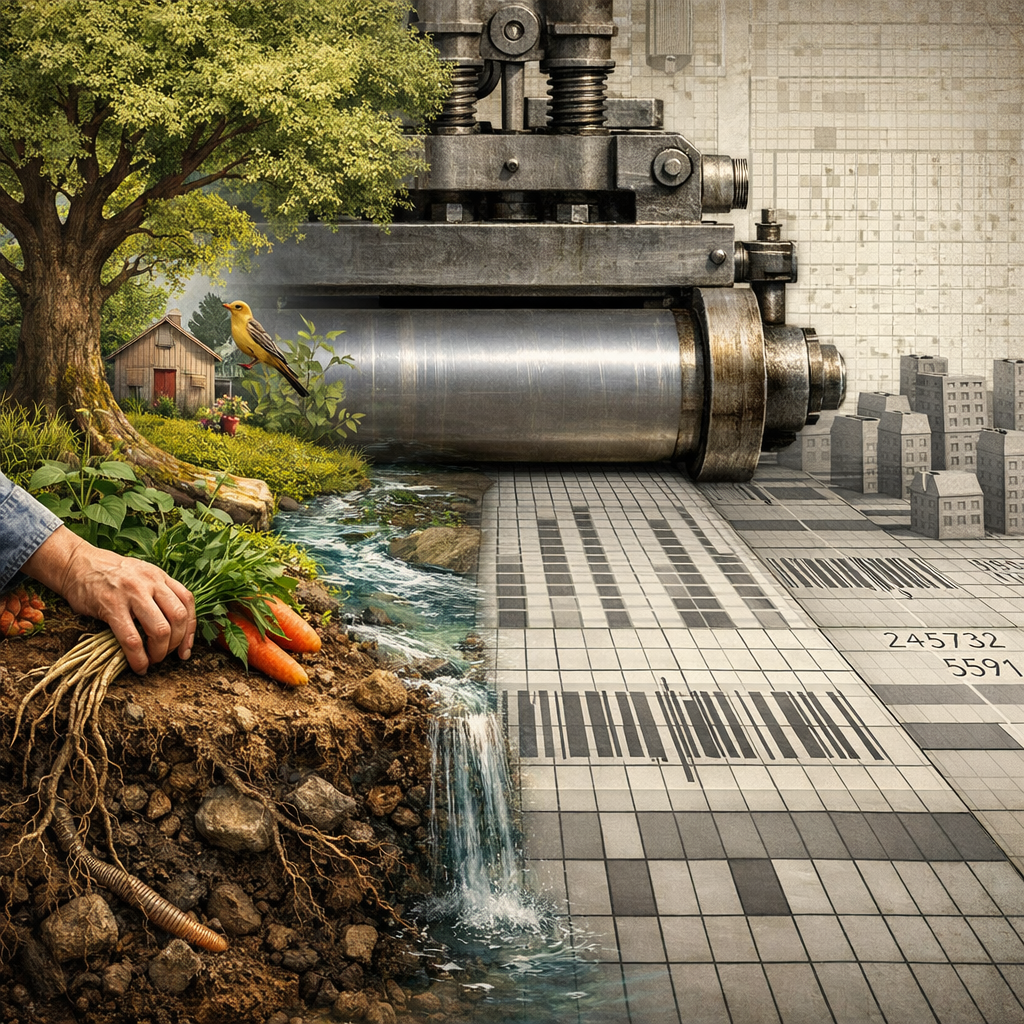
The Efficiency Trap by Matthew Salenger (with Aldo Nova)
Part 1 — revised
An Efficient Summary
Efficiency is one of humanity’s great tools. It has helped reduce labor, lower certain forms of waste, and make many goods and services easier to obtain. But efficiency becomes a trap when it stops being a tool and becomes our main way of deciding what matters.
We made food cheaper, but often lost flavor, biodiversity, soil health, and farmer independence. We made work faster, but lost attention, craft, and time to think. We made systems look efficient on paper while pushing their real costs into air, water, bodies, and future maintenance.
The goal of this paper is not to reject efficiency. The goal is to put it back in its place. It should serve a larger human aim: aliveness, health, resilience, and human meaning.
This opening is intentionally efficient. Its delivery is emblematic of the issue.
____________________________________________________________________________________
We are moving too fast to remain human.
By “human,” I do not mean nostalgic, anti-modern, or opposed to technology. I mean something more basic. Human beings learn with mind and body together. We learn through repetition and pattern, through direct contact with the real world, through relationships with other people, and through time. Trust takes time. Skill takes time. Judgment takes time. Belonging takes time. A culture worth inheriting takes time.
For most of human history, people lived in much more direct contact with consequence. Weather was not background; it shaped shelter, labor, hunger, movement, and risk. Soil was not abstract; it determined what could be grown and whether people would eat. Water was not a utility hidden in pipes; it was a source of life that had to be known, protected, and shared. People built with a closer awareness of climate, season, place, and limit because they had little choice. We have gained immense powers since then, but we have also lost part of that direct relationship. Much of modern life now works by insulating us from consequences until the consequences return in larger form.
That is where efficiency becomes dangerous. Not when it helps us do something better, but when it begins to force us to behave like machines: faster, thinner, more specialized, easier to manage, easier to count.
Efficiency, by itself, is not the villain. Better tools have always mattered. A sharper blade saves labor. A better pulley saves backs and shoulders. Improved sanitation saves lives. Good insulation reduces wasted energy. In that sense, efficiency is often a form of intelligence. It can express care, foresight, and respect for effort.
The problem begins when efficiency stops answering a limited question — how can we do this with less waste and more care? That is the real shift. Efficiency moves from tool to ideology.
An efficiency ideology does not say, “This is one good measure among many.” It says, usually without admitting it, that the fastest, cheapest, easiest-to-scale solution is the best one. It turns every problem into the same problem. How fast? How cheap? How much output? How many units? What is the return? What can be measured quickly? What can be standardized?
Once that way of thinking takes over, anything harder to measure starts to look secondary. Beauty becomes extra. Craft becomes inefficient. Repair looks less attractive than replacement. Ecological health becomes someone else’s problem. Community becomes a luxury. Long-term resilience is sacrificed to short-term convenience because resilience — and nature — are hard to count in a quarterly report, while speed and price fit neatly into a spreadsheet.
This is what I mean by thinning.
Thinning is what happens when we reduce a living reality to a narrow scorecard, and then build the world to satisfy that scorecard. We take something thick with relationships, consequences, memory, and meaning, and flatten it into a few metrics. Then we call the flattened version rational.
A building offers a simple example. Suppose a project is driven mainly by first cost and speed of construction. On paper, that looks efficient. The budget is lower. The schedule is shorter. The spreadsheet gives a clear answer. But the materials may age badly. The indoor air may be less healthy. The building may be harder to repair. Its maintenance costs may rise. Its beauty may be stripped down to whatever is quickest to repeat. Occupants may feel the difference every day without having language for it. What looked efficient at the beginning turns out to be expensive in operation, brittle in use, aesthetically impoverished, and extractive in spirit. The project did not eliminate cost. It moved cost out of sight.
That move — hiding cost by displacing it — is one of the central habits of the efficiency trap.
We see it in the air. Cheap power and fast transport feel cheap because the pollution does not remain where the transaction happened. It spreads into the atmosphere everyone shares. No single person appears fully responsible, so the system keeps going.
We see it in food. A system optimized for yield, shelf life, uniformity, and price can produce abundance in one sense while eroding soil, reducing nature’s diversity, weakening local independence, and severing our direct relationship with land. We may get more calories, more convenience, and more predictability while receiving less nourishment in the larger sense: less flavor, less resilience, less ecological intelligence, less contact with the true sources of life.
We see it in work. Organizations measure what is easy to count: output, availability, response time, productivity. But the things that make work worth doing — mentorship, pride, recovery, deep concentration, patience, knowledge, mastery built slowly over years — are harder to quantify. So they are trimmed away. The result is often not excellence, but burnout.
We see it in attention itself. The faster information moves, the less time people have to dwell with difficulty, complexity, or anything that asks for patience. This does not only make us distracted. It can also make depth feel confusing or alien. Work that takes years to learn, images that ask to be studied slowly, arguments that unfold over time — these begin to feel inaccessible to a culture trained by speed. We do not merely become rushed. We risk losing our feel for what ripening (a process of aging or reaching a state of full development) is.
That is why this trap matters. It is not just economic. It is moral, cultural, ecological, and physical. It changes not only what we build, but what we are able to notice, value, and become.
And once efficiency becomes the ruler of everything, the world begins its thinning around us.
Part 2 — When efficiency left the factory
This did not happen all at once. Others have described parts of the story. Edward Tenner shows that efficiency often backfires, producing new waste, lock-in, and missed possibilities. Jerry Muller shows how measurement can displace judgment. Elizabeth Popp Berman traces the rise of a policy culture in which efficiency gradually displaced equality as the master value. James C. Scott shows how large systems fail when they impose simplified schemes on living realities they do not truly understand. I am indebted to all of them. But my concern is slightly different. I am not only arguing that efficiency can fail on its own terms. I am arguing that when efficiency becomes a worldview, it thins life itself.
The roots of that worldview reach back before the Second World War. Frederick Winslow Taylor’s scientific management sought “maximum prosperity” through the systematic analysis of work, and Ford’s moving assembly line soon made that logic spectacularly visible by cutting Model T chassis assembly time from 12.5 hours to 1.5 hours. The achievement was real. Output rose. Prices fell. Standardization became a national ideal. Efficiency proved itself not just as a technique, but as a cultural promise.
After World War II, that logic escaped the factory and entered the landscape. The GI Bill gave returning veterans access to housing benefits, and the postwar suburb became one of the largest building booms in American history. FHA-backed standards, large developers, and later the Interstate Highway System made it possible to build and finance vast numbers of homes quickly and at scale. The achievement here was also real. Millions of families gained stability, privacy, and access to ownership. Any honest account has to say that plainly.
But the solution carried factory logic into everyday life. Housing was increasingly treated as a unit to be reproduced, financed, and separated from other functions with maximum predictability. Neighborhoods spread outward in nearly seamless fields of repetition. Daily life stretched across longer distances. Work, shopping, school, and home were pulled apart. More roads promised faster movement, yet highway agencies themselves acknowledge the basic logic of induced demand: added capacity attracts additional traffic. In time, the “efficient” landscape required more driving, more paving, more infrastructure, and more fuel simply to maintain ordinary life. Transportation became the largest source of U.S. greenhouse-gas emissions, accounting for 29% in 2022. The time saved in one place was often re-spent in another.
Something else was displaced as well: justice. The postwar system distributed its benefits unevenly. The National Archives notes that Black veterans were often unable to obtain mortgage loans in Black neighborhoods and were widely excluded from white suburban neighborhoods. What was presented as a universal path to prosperity was never universal. Efficiency did not erase politics; it concealed politics inside standards, financing structures, and supposedly neutral systems of access.
This is why postwar housing matters so much as an example. It shows efficiency solving a real problem while simultaneously narrowing the terms of life. It gave many families shelter and security, but it also normalized distance, standardization, auto dependence, hidden pollution, and social sorting. It made one way of living feel natural because it was scalable. That is one of efficiency’s most powerful tricks: once a system is repeated enough times, it stops looking like a choice and starts looking like common sense.
Housing is only one chapter in the story. Agriculture tells another. The Green Revolution dramatically increased yields and helped avert famine in densely populated regions, but even institutions sympathetic to its achievements have acknowledged the environmental and social damage caused by monoculture, heavy inputs, and the neglect of local ecological knowledge. Governance tells another. As Berman argues, modern policy increasingly learned to ask not what is just, but what is efficient. The same pattern appears again and again: a narrow measure solves one urgent problem, then quietly expands until it begins reorganizing the whole field of value.
That is the deeper history I want to trace. Efficiency did not merely help us make things. It began to tell us what things were for. And once that happened, we stopped asking enough questions about what kinds of lives our systems were actually producing.
Part 3 — Agriculture and the nitrogen bargain
Agriculture may be the clearest example of efficiency’s double face, because the gains were real and the losses were real.
Any serious account has to begin there. The modern agricultural turn fed vast numbers of people. The Haber-Bosch process made industrial nitrogen fertilizer possible at scale, and UNEP notes that this was followed by a spectacular increase in global food production. In many places, high-yield seeds, irrigation, fertilizers, pesticides, and mechanization helped societies avoid famine and increase output far beyond what older systems could provide. That achievement should not be sneered at. It answered a genuine human emergency.
But it also changed the question agriculture was asking.
For most of human history, farming was not only about output. It was also about stewardship, timing, local weather, soil character, stored knowledge, limits, and reciprocity with a living place. It was never idyllic; it was hard, uncertain, and often punishing. But it required a relationship with land that could not be fully abstracted. Industrial agriculture, by contrast, increasingly treated the farm as a production surface. The goal became clear: more yield, more uniformity, more predictability, more shelf life, more calories per acre, more resistance to interruption, more product moving through the system.
That shift produced astonishing abundance. It also produced simplification.
Fields became monocultures. Seed diversity narrowed. Farms grew larger and often more dependent on purchased inputs. Local judgment was increasingly subordinated to generalized recipes: this seed, this fertilizer rate, this spray schedule, this market channel. What had once been a situated practice became, in many places, a system optimized for repeatability. That is the efficiency trap in agricultural form: not merely growing more food, but reorganizing the whole living complexity of farming around a few preferred outputs.
And once that happened, the displaced costs began to accumulate.
The most striking example is nitrogen. Nitrogen is essential to life. Crops need it. But when industrial systems learned to fix atmospheric nitrogen at massive scale and apply it as fertilizer, they did not simply help plants grow. They altered a planetary cycle. Stockholm Resilience Centre identifies biogeochemical flows — especially nitrogen and phosphorus — as one of the boundary systems humanity has pushed beyond a safe operating range. UNEP likewise notes that the same breakthrough that enabled huge gains in food production also led to severe nitrogen pollution. What looks like a triumph of efficiency inside the field can become instability outside it.
This is where the truth gets more uncomfortable. The fertilizer does not all stay where it is placed. FAO has noted that only about half of the fertilizer applied may actually benefit crops; the rest can be lost through leaching, runoff, and volatilization. Our World in Data reports that agriculture drives 78% of global ocean and freshwater eutrophication — the nutrient overloading of waterways that can trigger algal blooms, oxygen depletion, and ecological collapse. In other words, the system did not eliminate waste. It exported waste into rivers, lakes, coasts, and atmosphere, where the bill is paid more diffusely and less visibly.
This matters for the essay because it sharpens the core pattern. Efficiency often looks admirable at the point of production because that is where the metric is cleanest. Bushels per acre. Tons per hectare. Price per unit. Speed to market. But the metric is clean partly because the world outside the metric has been dirtied. Water absorbs what the spreadsheet does not. Soil absorbs what the quarterly report does not. Rural communities absorb what the global commodity chain does not. The atmosphere absorbs what the farm budget does not. Once again, cost has not disappeared. It has been displaced.
And something human is displaced too.
A food system optimized mainly for yield and uniformity weakens our felt relationship to the sources of life. We still eat, but often with less awareness of season, watershed, soil, biodiversity, and husbandry. We receive food more reliably and more cheaply in one sense, yet the culture around food can become thinner: less place-specific, less diverse, less connected to the people and ecologies that make nourishment possible. Efficiency gives us abundance while quietly removing us from the living processes abundance depends on.
That is why I do not want this section to become a sentimental attack on technology or modern farming. The truth is harder, and therefore more useful. Industrial agriculture solved real problems. It also created new dependencies and moved consequences outward into systems large enough that most people no longer perceive the link between cause and effect. That is the bargain. We gained output and predictability, but often by simplifying life into an industrial logic that does not know how to count fertility except as input, land except as substrate, or nature except as a set of controllable variables.
When that mentality spreads, it does not stay in agriculture. It becomes a general model for how to think. If land is most valuable when it is optimized, then so is labor. So is policy. So is education. So is attention. The farm becomes one more training ground for a civilization that believes whatever can be standardized can be improved, and whatever cannot be easily measured is secondary.
That is why agriculture belongs here in the essay. It does not merely show environmental damage. It shows efficiency becoming a worldview. It shows a system that was praised for feeding the world also teaching us to mistake simplification for wisdom. And once we accept that habit in one domain, it becomes easier to accept it everywhere else.
Part 4 — When efficiency becomes politics
Once efficiency escapes the factory and the farm, it does not stop at material systems. It enters the language of governance itself. At that point, a society does not merely ask how to make things faster or cheaper. It begins asking a narrower set of political questions: What works? What scales? What produces measurable gains? What can be justified in a cost-benefit frame? Those questions are not foolish. Often they are useful. But once they become the dominant questions, older political questions begin to recede: What is just? What makes a place worth inhabiting? What forms of dependence are dangerous? What kinds of human beings are our systems training us to become? Elizabeth Popp Berman’s work is so helpful here because she shows how an “economic style of reasoning” came to dominate U.S. policy debate, narrowing the horizon of what could even be proposed.
This helps explain why modern politics can feel bloodless and overheated at the same time. It becomes bloodless because public life is translated into management language — optimization, incentives, outcomes, growth, efficiency, performance. But it also becomes overheated because whatever cannot find a place inside that administrative vocabulary returns in distorted form: resentment, spectacle, tribal identity, moral panic. A culture cannot live by metrics alone. When politics forgets how to speak about meaning, place, memory, and belonging, those things do not disappear. They come back in harsher and less governable ways. That is one of the hidden costs of efficiency as a ruling value: it strips public language of thickness, then acts surprised when people seek intensity elsewhere.
We saw a version of this in Cambridge Analytica. The company became notorious not simply because it worked for Donald Trump’s 2016 campaign, but because the scandal revealed a deeper ambition: to make political language more efficient through data extraction, segmentation, and continual behavioral refinement. Regulators and privacy advocates documented that Facebook user data had been harvested without proper consent, and that Cambridge Analytica had used such data in political work. Whether its psychographic methods were truly as powerful as advertised is less important here than the aspiration itself. Politics was being treated less as public persuasion among citizens than as a technical exercise in precision targeting.
Brexit showed a parallel pathology. The famous claim that leaving the European Union would free up £350 million a week for the NHS was false, yet it was efficient in exactly the way propaganda often is: simple, sticky, emotionally legible, and easy to repeat. It compressed a hugely complicated political and economic question into a slogan built for circulation. And importantly, the official UK investigation said it found no evidence that SCL/Cambridge Analytica had actually done data-analytics work for the referendum campaigns. That distinction matters. Cambridge Analytica is the example of optimized targeting; the NHS bus slogan is the example of the efficient lie. Together they show how modern politics can be thinned from two directions at once: behavioral engineering on one side, memorable falsehood on the other.
This is the deeper problem. Efficiency in politics does not only make campaigns sharper. It can make truth more disposable. It can reward whatever message travels fastest, whatever phrasing triggers the cleanest emotional response, whatever narrative reaches the persuadable voter with the least friction. In that environment, citizens are no longer treated primarily as participants in a shared public world. They become targets, segments, behavioral types, audiences to be moved. The aim is no longer understanding. The aim is conversion. And once that becomes normal, discord itself can become politically useful.
Education has its own version of the efficiency trap. Schools built on a factory model move students through standardized, disconnected lessons and assessments designed for coverage, comparison, and throughput — the rapid movement of students through a system in legible, comparable batches. The Learning Policy Institute notes that traditional high schools were structured for efficiency, and that state tests have been designed with trade-offs that favor efficiency and reliability over impact on teaching and learning. The result is not necessarily ignorance in the old sense, but something more fragile: students can accumulate content without being equally trained to follow an argument, weigh evidence, or judge the credibility of what they read. That weakness now shows up plainly. NAEP reports that 2024 reading scores continued their decline, with twelfth-grade reading at the lowest level yet recorded, and Stanford’s Digital Inquiry Group found that 3,446 high school students struggled across six online reasoning tasks. A system that prizes coverage, pacing, and legible outputs over inquiry does not simply produce weaker readers. It can also produce citizens less practiced in resisting manipulation.
This is also where a figure like Bill Gates becomes useful — not because he is uniquely guilty, but because he personifies a familiar modern faith: that large, complex human problems can be solved through innovation, capital, and scalable systems of optimization. In his 2025 climate essay and in the Gates Foundation’s 2025 adaptation commitment for smallholder farmers, the framing is benevolent, pragmatic, and deeply concerned with human welfare. There is truth in that posture. Human welfare matters. Practical help matters. But the trouble is that such systems, even when benevolently framed, can deepen dependence, flatten local knowledge, and push living realities into forms that are easier to measure than to inhabit.
His farmland holdings sharpen the symbolism. Bill Gates remains the largest private farmland owner in the United States, with about 242,000 acres. But again, the larger pattern matters more than the person. USDA’s latest TOTAL survey says that 79% of rented U.S. farmland acres are owned by non-farming landlords. That means Gates is not the whole story. He is a vivid sign of the story: even the ground beneath our food is increasingly easy to understand as an asset, managed at a distance and valued for performance. Once land is translated into portfolio logic, stewardship can begin answering to scale, return, and abstraction before it answers to place.
So the problem is not simply that efficiency has produced bad outcomes in one domain or another. The deeper problem is that it has taught us to mistake legibility for wisdom. A system begins by trying to count what matters. Before long, it quietly redefines mattering itself in terms of what can be counted. That is the political and cultural achievement of the efficiency worldview. It does not merely solve problems. It trains perception. It teaches whole societies to trust what is measurable, scalable, and administratively clean, while losing confidence in forms of knowledge that are slower, local, relational, and embodied. And once that habit takes hold, even care can become managerial. Even good intentions can become extractive. Even intelligence can become a way of not seeing.
But there is a counter-idea, older than the modern cult of efficiency and closer to the way human beings have lived for most of history: that life is not mastered by optimization alone. It is understood through relationship, feedback, memory, attention, and participation in living systems larger than ourselves. If efficiency thins the world by treating it as something to manage from above, the counter-movement begins by returning us to what can only be known from within.
Part 5 — The human speed limit
The alternative to the efficiency trap is not laziness, primitivism, or a romantic rejection of modern life. It is a recovery of proportion — and of older priorities we have partly abandoned: relationship, stewardship, reciprocity, and a more direct connection to the natural world that still makes life possible.
There is a pace at which human beings seem better able to understand what they are doing. At that pace, life feels fuller, rounder, and more legible. Trust has time to form. Judgment has time to ripen. Skills have time to deepen. Children have time to mature. Places have time to reveal themselves. Communities have time to learn from consequence. We can accelerate many processes, but not all of them. Some forms of development are damaged when pushed too fast. Some forms of knowledge only appear through duration, attention, and lived relationship.
This is what the efficiency worldview has such difficulty recognizing. It assumes that delay is usually a flaw, friction is usually waste, and slowness is usually a problem to be solved. But in living systems, friction is often feedback. Delay is often instruction. Slowness is often what allows perception to become accurate. A forest does not become healthier because it grows faster than its own conditions can sustain. A child is not educated because more content has been pushed through more quickly. A community is not necessarily strengthened because more housing units have been delivered to it with greater speed. In each case, something essential depends on timing, sequence, and reciprocal fit.
So perhaps the point is not that human beings have one fixed speed limit. It is that there are limits to how much life can be accelerated before understanding begins to break down.
We ignore those limits at our peril. When work is accelerated beyond the pace at which craft can develop, workers become interchangeable and the work becomes hollow. When education is accelerated into coverage and testing, students may accumulate content while losing the ability to follow an argument or discern a lie. When politics is accelerated into targeting and outrage, citizens are converted into reactive audiences. When land is accelerated into production and asset logic, fertility is mined faster than relationship can repair it. What breaks in each case is not merely quality. It is the living bond between action and understanding.
For most of human history, people learned through embeddedness. Knowledge was not primarily delivered as abstract content detached from context. It was learned in households, fields, workshops, ceremonies, guilds, apprenticeships, and shared forms of labor. That older world was not automatically just or gentle. But it did preserve an important truth: to know something well, you usually had to live with it. You had to feel consequence, repetition, weather, resistance, failure, repair, and season. Knowledge was not only in the head. It was in the body, in shared practice, in memory, and in the ongoing adjustment between people and place.
Modernity brought tremendous gains by loosening some of those bonds. We should say that clearly. Abstraction allowed knowledge to travel. Science allowed us to see patterns no village tradition could have grasped on its own. Institutions enabled medicine, sanitation, literacy, engineering, and forms of prosperity that would once have seemed miraculous. The problem is not abstraction itself. The problem is forgetting that abstraction is partial. Once abstract systems become primary, they begin to override the thicker realities from which they were originally derived.
That is why the answer cannot be simply “more humane efficiency.” The answer has to be a reordering of values. Efficiency must be placed inside a larger understanding of what human beings are and what living systems require. It must be disciplined by things it cannot generate for itself: stewardship, reciprocity, beauty, memory, local knowledge, repair, patience, and the willingness to let some forms of growth occur at their proper pace.
This is where discernment begins. Discernment is not the opposite of intelligence. It is intelligence slowed down enough to become wise. It asks different questions from the efficiency worldview. Not merely: Does it work? Does it scale? Is it faster? Is it cheaper? But also: What kind of person does this produce? What dependencies does it create? What does it hide? What does it exhaust? What forms of life does it make harder to sustain? What knowledge does it displace? What reality is pushed out of sight so that the system can appear clean? It also asks whether our tools are repairing or weakening our bonds with the external world — with land, body, community, and the larger patterns that sustain life. Discernment makes human limits visible again, not as insults to ambition, but as conditions for sanity, reciprocity, and durable freedom.
Those are older questions. They are also future questions.
The next temptation is already visible. If human beings cannot keep pace with the systems we have built, perhaps we should redesign the human being. Brain-computer interfaces such as Neuralink are presented, quite rightly, as potential tools for restoring autonomy to people with profound physical disabilities. That good should be honored. But the larger fantasy surrounding such technologies is more revealing: that the way out of the efficiency trap is not to recover proportion, stewardship, and human limits, but to retrofit the person so the system never has to slow down. It is the shortcut version of progress — not earned adaptation, but technical escape. At that point, the problem is no longer merely that systems are optimized. It is that the human person is invited to become the next object of optimization, and perhaps even the biological support system for computational goals set elsewhere.
And once we begin asking those older and future questions again, the world starts to thicken. Land becomes more than a unit of production. A school becomes more than a delivery system for content. A building becomes more than a cost problem. Politics becomes more than message management. Work becomes more than output. The goal is not to make life inefficient. It is to make it fully legible again to human beings — so that we can return to the distinctively human work of shaping our institutions, tools, and places in creative reciprocity with one another and with the natural world, for the balance and benefit of living systems rather than their exhaustion.
Part 6 — What thicker systems look like
“To live is not merely to breathe; it is to act; it is to make use of our organs, senses, faculties—of all those parts of ourselves which give us the feeling of existence.”
“Our minds — like our arms — are accustomed to use tools for everything, and to do nothing for themselves.”
— Jean-Jacques Rousseau (quotes from Emile, or On Education)
We do not have to imagine a world beyond the efficiency trap entirely from scratch. Human beings have repeatedly built ways of living that worked with natural systems rather than simply imposing upon them. Those systems were not perfect, and they should not be romanticized. But they do show that productivity, resilience, community, and human meaning do not have to come from simplification alone. They can also come from fit, reciprocity, and forms of knowledge accumulated through long intimacy with place.
Acequia communities in the arid Southwest offer one such example. In New Mexico, acequias are not merely irrigation ditches. They are shared systems of water, labor, governance, and memory. They depend on gravity more than machinery, on local maintenance more than remote management, and on cooperation more than abstraction. Water is not treated as a detached commodity moving through a neutral pipe. It is part of a lived commons, governed by people who must continue showing up for one another and for the land that feeds them.
The chinampas of Mexico City point in a similar direction. Historically, chinampas were built within a wetland ecology rather than in place of one. Raised fields, canals, and rows of native willows formed an unusually productive system precisely because it worked with water, soil, edge condition, and maintenance as one living arrangement. In that sense, human intervention did not simply exploit the wetland; it also sustained a landscape in which ecological richness and cultivation could reinforce one another. Much of that broader wetland system was later reduced by urbanization, and the surviving chinampa zones are now only a fragment of what once existed. Even so, they still show that people and wetland ecologies can benefit one another when productivity is organized through reciprocity rather than flattening.
The Japanese terms satoyama and satoumi widen the frame further. Satoyama refers to managed rural mosaic landscapes — woodlands, grasslands, farms, ponds, canals, and settlements — where human use and ecological health have long been intertwined. Satoumi extends that insight to coastal waters: seascapes where human care can increase both biological productivity and biodiversity. The lesson is not only about a field or an irrigation channel, but about a whole mosaic of interdependence. This matters for the essay because it shows that thick systems do not require untouched wilderness. They can include human settlement, cultivation, harvest, and built form. What matters is whether the system is organized around reciprocal maintenance and ecological fit, or around extraction disguised as efficiency.
This is one reason Julia Watson’s Lo-TEK: Design by Radical Indigenism feels so relevant here. The value of that book is not that it gives us picturesque precedents to admire from a distance. Its value is that it treats Indigenous and vernacular systems as living technologies — nature-based, place-specific, and sophisticated — rather than as primitive leftovers waiting to be replaced. It helps name an alternative design intelligence: one that works with flux, local ecology, and inherited knowledge instead of assuming that the future must always arrive through harder systems, more energy, and greater abstraction.
The point is not to copy any of these systems literally into the present. We are not going to solve modern housing, food, or governance by pretending we live in another century. The point is to recover the principles they embody. Shared maintenance rather than anonymous dependence. Local adaptation rather than universal template. Redundancy rather than brittle streamlining. Embedded knowledge rather than distant management. Production that strengthens relationship instead of severing it. Beauty that arises from participation in a place rather than indifference to it.
That shift matters far beyond agriculture. A building can be more like an acequia than a machine: shaped by climate, maintained with care, and made to deepen relationship rather than conceal consequence. A school can be more like a craft tradition than a pipeline of student tests: slower, more demanding, more interpretive, more human. A politics can be more like satoyama than message warfare: a patient tending of overlapping systems rather than a constant race for advantage. The forms will differ, but the question remains the same. Are we designing for throughput, or are we designing for life?
The world will not become thicker because we denounce efficiency in the abstract. It will become thicker when we begin building and rebuilding systems that honor sequence, maintenance, reciprocity, and fit. That is not regression. It is a more mature modernity: one willing to use science and technique, but unwilling to let them define reality by themselves. It will also not be easy. It will take will, time, and discipline.
Part 7 — Five Capitals and the Measure of Wealth
If we are going to escape the efficiency trap, we need more than better intentions. We need a better way of judging success. One of the reasons efficiency became so powerful is that it offered a simple metric: more output, less input, faster delivery, lower cost. That clarity has appeal. But it also carries a danger. Any measure simple enough to travel everywhere can begin to erase the very things it cannot register. If we want to build systems that remain alive, then we need forms of measurement that do not kill what they claim to protect.
This is where the Five Capitals framework becomes useful. Its value is that it offers a practical reminder: wealth is not the same thing as money. A society can be flush with financial capital and still be deeply impoverished in other ways. It can exhaust its soils, fray trust, weaken skill, hollow out public life, and build disposable infrastructure — all while telling itself it is succeeding because the spreadsheets look strong. The Five Capitals framework asks us to look again. It names several forms of wealth that must be cultivated together if the whole system is to remain healthy: natural, social, human, built, and financial capital.
Natural capital is the living foundation. It includes soil fertility, biodiversity, forests, wetlands, aquifers, pollinators, stable climate patterns, and the larger cycles that make life possible. The efficiency worldview tends to treat these as background conditions, or as resources to be drawn down in the service of production. But they are not merely inputs. They are generative systems. A healthy watershed is wealth. Soil that deepens in fertility is wealth. Native habitats that support pollination, seed dispersal, and resilience are wealth. When a culture restores degraded land, repairs water cycles, increases biodiversity, or builds with the grain of climate rather than against it, it is not indulging in environmental sentiment. It is protecting the base layer upon which every other form of wealth depends.
Social capital is different, but no less real. It is the wealth held in trust, reciprocity, shared norms, mutual obligation, and the belief that one’s fate is linked to the fate of others. It includes the invisible architecture of cooperation: the neighbor who shows up, the local institution people still trust, the civic habit of solving problems together, the public space where strangers become less strange. Social capital is what allows a community to act as more than a collection of private interests. It requires, in some form, a sense of interlinked destiny. Without that, social life becomes transactional and brittle. With it, a place can absorb difficulty without coming apart. Efficiency often undervalues this because trust is slow to build and hard to quantify. Yet every society that has endured has depended upon it.
Human capital brings the focus closer to the person. It includes health, skill, knowledge, judgment, creativity, agency, and the ability to do meaningful work. But it also includes the transmission of knowledge across generations. A culture becomes wealthier when children learn from elders, when trades are passed on, when craft deepens, when education forms capable adults rather than merely credentialed ones, and when people are given real opportunities to exercise judgment rather than simply follow procedure. A society obsessed with speed and throughput can produce trained specialists while still weakening human capacity in a deeper sense. It can generate information while eroding wisdom. It can create labor markets while diminishing vocation. Human capital grows when people are allowed to become more fully competent, more fully responsible, and more fully themselves.
Built capital, sometimes called manufactured capital, is the world we make. It includes buildings, roads, tools, utilities, transit, public spaces, schools, water systems, and the countless artifacts that support daily life. The efficiency trap often treats built capital as a problem of minimum cost and maximum output. But the real question is not whether something can be built cheaply. It is whether it can serve life well over time. Durable infrastructure is wealth. Repairable tools are wealth. Buildings that are healthy, maintainable, climatically responsive, and loved enough to be cared for are wealth. A city full of cheaply made, rapidly failing, psychologically deadening structures may look productive in the short run, but it is often passing hidden costs into the future. Built capital should not merely be extensive. It should be worthy of stewardship.
Financial capital has its place, and it matters. Money is not the enemy. Finance helps things happen. It makes projects possible, absorbs risk, coordinates investment, and allows long-term efforts to be organized and sustained. The problem comes when financial capital stops serving the whole and begins demanding that every other form of capital justify itself in its terms alone. At that point, finance ceases to be a servant and becomes a master. When that happens, natural systems are liquidated, social trust is spent down, human beings are treated as cost centers, and buildings become short-term instruments rather than long-term civic goods. Properly understood, financial capital should support long-term thriving. It should help align action with stewardship, not reward extraction because extraction pays faster.
What makes the Five Capitals framework so useful is that it does not merely add more categories. It changes the shape of judgment itself. It forces us to ask whether one apparent gain is quietly destroying four other forms of wealth. A project can be financially profitable while degrading land, weakening community, reducing human agency, and producing brittle infrastructure. In such a case, calling it a success is not realism. It is blindness. By the same token, a project that appears slower, more demanding, or less profitable at the outset may be enormously intelligent if it strengthens several forms of capital at once. The framework does not eliminate tradeoffs. But it makes them harder to hide.
This is one reason it belongs late in the essay. By now, we have seen how the efficiency worldview narrows attention and trains us to mistake administrative clarity for truth. The Five Capitals framework offers a concrete antidote. It widens the field again. It gives us a way to measure without collapsing reality into one dimension. And in that sense, it does not only describe healthier systems. It performs one. It asks people, institutions, companies, governments, and communities to think in relation rather than isolation.
Seen this way, Five Capitals is not only a framework for evaluation. It is also a framework for alignment. It helps reveal why so many modern efforts fail even when their intentions are decent: each actor is optimizing a different narrow metric while the larger system quietly degrades. Governments chase administrative efficiency. Companies chase quarterly returns. Designers chase novelty or compliance. Citizens chase affordability and convenience. None of those aims is trivial. But when they remain uncoordinated, the whole becomes thinner, more fragile, and less capable of supporting life. A plural understanding of wealth makes another possibility visible: that people and institutions might organize around keeping the whole system healthy, rather than maximizing advantage within a damaged one.
That larger claim leads naturally toward circular economy and regenerative development, though those phrases can sometimes sound more exotic than the underlying truth. The truth is simple enough. A healthy society learns how to keep value circulating rather than constantly extracting, discarding, and externalizing. It learns how to repair the sources of its own life while meeting present needs. It learns how to build in ways that increase future possibility instead of narrowing it. In this sense, the Five Capitals framework is not a side concept. It is a disciplined way of remembering what an economy is for.
And that may be the deepest point. An economy is not successful because it moves money quickly. A society is not wealthy because it can point to growth in one column. Real wealth is plural. It lives in the land, in the body, in the craft, in the trust between people, in the durability of what we build, and in the financial means that help sustain all of it. Once we see that clearly, efficiency can take its proper place. It remains useful. It may even be indispensable at times. But it is no longer allowed to define the whole of value. It becomes a tool within a larger human purpose: not merely to produce more, but to keep the world alive enough for life to go on becoming more fully itself.
Part 8 — Flatland and the discipline of seeing more
Edwin Abbott’s Flatland endures because it is not only a satire of Victorian society. It is also a parable about reduction. Its deepest warning is not merely that people can be trapped inside rigid systems. It is that whole worlds can be organized around a diminished way of seeing and then mistaken for reality itself.
In Flatland, the inhabitants live within the logic of a geometric and flat plane. Their world is orderly, legible, and tightly bounded by what can be perceived from within it. That limitation does not only shape what they know. It shapes what they believe is possible. When another dimension appears, it is not simply difficult to understand. It is nearly unthinkable. The problem is not just ignorance. It is formation. They have been shaped by a world that makes certain truths almost impossible to perceive.
That is why the book belongs here. The efficiency trap is, in its own way, a modern Flatland. It takes a thick and living reality and presses it into a thinner system of value. It rewards what can be counted quickly, standardized broadly, priced cleanly, and managed at scale. It turns the world toward legibility. In doing so, it gives us genuine powers. We can coordinate supply chains, compare outputs, reduce some forms of waste, expand access, and solve real problems with impressive speed. But the very act of flattening also removes depth. It makes some forms of life easier to administer while making other forms harder to recognize.
Flatland helps clarify the cost. A reduced world becomes more controllable, but it also becomes smaller. It may function well by its own rules while losing touch with realities those rules cannot register. It can become highly competent at operating inside a narrow frame while growing less capable of encountering what exceeds it. That is the shape of much contemporary life. We know more and more how to optimize systems from within the plane, yet often seem less able to ask whether the plane itself is too thin for human flourishing.
This is not an argument against knowledge, discipline, or rigor. It is an argument for a richer kind of formation. The people we most need are not merely informed. They are well-formed. They are practice-trained. They are discerning. They are capable of seeing more. They can recognize that a model is not the same thing as a place, that a metric is not the same thing as a life, that an efficient procedure is not the same thing as a good society. They understand that reality has layers, and that the health of a system often depends on what is hardest to measure: trust, beauty, memory, attachment, judgment, reciprocity, meaning, and the living ground beneath all of it.
That kind of perception does not arrive automatically. It has to be cultivated. It is learned through experience, through attention, through craft, through contact with consequences, and through participation in worlds that resist simplification. A well-formed builder learns to read materials, weather, and use. A well-formed citizen learns that public life depends on obligations that cannot be reduced to transaction. A well-formed designer learns that the best solution on paper may still be wrong for the life of a place. A well-formed culture teaches people how to see interdependence before crisis makes it unavoidable.
This may be the deepest failure of the efficiency worldview: not only that it damages systems, but that it trains perception poorly. It teaches us to look for what is easy to extract from reality rather than what reality is asking of us. It encourages competence within narrow frames while weakening our ability to perceive the wider field. Over time, that becomes a civilizational problem. We produce people who are increasingly skilled at operating systems they did not shape, increasingly dependent on abstractions they cannot evaluate, and increasingly estranged from the living contexts that make judgment possible in the first place.
The answer is not to abandon measurement, technology, or organization. It is to refuse their monopoly on truth. We need forms of education, practice, design, and governance that help people perceive thickness again. We need habits that restore dimensionality to the world: time in actual places, contact with materials and maintenance, institutions that reward judgment, economies that recognize plural forms of wealth, and public cultures that treat citizens as participants rather than inputs. We need to become capable of seeing more than the flat projection.
That is why this essay has argued, again and again, that the problem is not efficiency in itself. Efficiency can be useful, elegant, even merciful. It can reduce drudgery, conserve effort, and make good things more available. But once it escapes its proper bounds, it begins to flatten the world in order to master it. And a flattened world, however manageable, is not enough for human beings. Nor is it enough for the larger living systems upon which human beings depend.
We do not need a less intelligent society. We need a deeper one. We need one that can use tools without becoming tool-shaped. One that can measure without worshipping the measure. One that can organize without forgetting what community is for. One that can build, farm, govern, teach, and make art in ways that enlarge life rather than compress it.
Efficiency is a tool. Aliveness is the aim.
What We Can Do…
The Efficiency Trap is not escaped through a single reform, product, app, policy, or personal habit. That would be the logic of efficiency speaking again: the promise of a simple fix for a complex condition.
But we can begin by noticing where life has been made too fast, too abstract, too optimized, or too thin.
We can spend more time outdoors — not as recreation alone, but as a way of returning our nervous systems to the scale of weather, light, plants, animals, seasons, and actual places. We can walk where we live and learn the names of streets, trees, washes, buildings, neighbors, and local histories. We can become less like consumers passing through a landscape and more like citizens belonging to one.
We can refuse the false urgency of the phone. We can limit social media, and never surrender our attention to doom scrolling — that strange ritual where the world appears to be known, but nothing is actually understood. We can choose depth over feed, conversation over reaction, and silence over constant input.
We can eat in ways that honor the living systems that feed us. Not perfectly. Not dogmatically. But with more awareness of soil, labor, animals, water, distance, waste, and consequence. Every meal is connected to a world.
We can travel more slowly when possible. Driving between cities instead of flying is not always practical, but when we do it, we remember that places are not isolated dots connected by airports. They are part of a continuous terrain. The land between destinations matters. The journey teaches.
We can repair things. We can maintain things. We can cook, garden, draw, read, walk, build, mend, volunteer, mentor, and participate in local life. We can support schools, libraries, small businesses, public spaces, cultural institutions, and the people who keep communities alive.
Most of all, we can resist the idea that the fastest, cheapest, easiest answer is always the best one.
A human life requires friction. It requires attention. It requires limits. It requires beauty, responsibility, and time.
So maybe the work ahead is not to reject efficiency entirely. The work is to put it back in its proper place.
Efficiency should serve life.
It should not define it.
And when it begins to make us less human, we should have the courage to slow down, step outside, look around, and begin again.
Please provide comments on this Essay on our webpage https://www.colabstudio.com/subjects/the-efficiency-trap to create a dialog with the author.
Working Bibliography
Extended working bibliography for the essay draft
Updated March 20, 2026
Foundational books and essays
· Berman, Elizabeth Popp. Thinking Like an Economist: How Efficiency Replaced Equality in U.S. Public Policy. Princeton, NJ: Princeton University Press, 2022.
· Berry, Wendell. “Faustian Economics.” Harper’s Magazine, May 2008.
· Haber, Samuel. Efficiency and Uplift: Scientific Management in the Progressive Era, 1890–1920. Chicago: University of Chicago Press, 1964.
· Muller, Jerry Z. The Tyranny of Metrics. Princeton, NJ: Princeton University Press, 2018.
· Scott, James C. Seeing Like a State: How Certain Schemes to Improve the Human Condition Have Failed. New Haven, CT: Yale University Press, 1998.
· Taylor, Frederick Winslow. The Principles of Scientific Management. New York: Harper & Brothers, 1911.
· Tenner, Edward. The Efficiency Paradox: What Big Data Can’t Do. New York: Alfred A. Knopf, 2018.
· • Rousseau, Jean-Jacques. Discourse on the Origin of Inequality. Indianapolis: Hackett Publishing Company, 1992
Additional books for Part 6 and later sections
· Abbott, Edwin A. Flatland: A Romance of Many Dimensions. Oxford: Oxford University Press, 2008.
· Barzun, Jacques. From Dawn to Decadence: 500 Years of Western Cultural Life, 1500 to the Present. New York: HarperCollins, 2000.
· Davis, Mike. Dead Cities: And Other Tales. New York: The New Press, 2002.
· Sanford, Carol. The Regenerative Life: Transform Any Organization, Our Society, and Your Destiny. London: Nicholas Brealey, 2020.
· Sennett, Richard. The Corrosion of Character: The Personal Consequences of Work in the New Capitalism. New York: W. W. Norton, 1998.
· Sennett, Richard. The Craftsman. New Haven, CT: Yale University Press, 2008.
· Sennett, Richard. The Fall of Public Man. New York: W. W. Norton, 1977.
· Watson, Julia. Lo-TEK: Design by Radical Indigenism. Cologne: Taschen, 2019.
Biophilia, Five Capitals, and regenerative frameworks
· Browning, William D., Catherine O. Ryan, and Joseph O. Clancy. 14+ Patterns of Biophilic Design: Improving Health and Well-Being in the Built Environment. 10th Anniversary ed. New York: Terrapin Bright Green, 2024. Accessed March 20, 2026. https://www.terrapinbrightgreen.com/report/14-patterns/
· Goodwin, Neva R. “Five Kinds of Capital: Useful Concepts for Sustainable Development.” Working Paper 03-07. Boston: Global Development and Environment Institute, Tufts University, 2003. Accessed March 20, 2026. https://www.bu.edu/eci/2003/09/05/five-kinds-of-capital-useful-concepts-for-sustainable-development/
· Kellert, Stephen R. Nature by Design: The Practice of Biophilic Design. New Haven, CT: Yale University Press, 2018.
· Kellert, Stephen R., and Edward O. Wilson, eds. The Biophilia Hypothesis. Washington, DC: Island Press, 1995.
Historical and archival sources
· National Archives. “Servicemen’s Readjustment Act (1944).” Accessed March 19, 2026. https://www.archives.gov/milestone-documents/servicemens-readjustment-act
· National Park Service. Historic Residential Suburbs: Guidelines for Evaluation and Documentation for the National Register of Historic Places. Washington, DC: U.S. Department of the Interior, 2020. Accessed March 19, 2026. https://www.nps.gov/subjects/nationalregister/upload/NRB46_Suburbs_part1_508.pdf
· Roosevelt, Theodore. “The New Nationalism.” Speech delivered at Osawatomie, Kansas, August 31, 1910. Theodore Roosevelt Center. Accessed March 19, 2026. https://www.theodorerooseveltcenter.org/digital-library/o308460/
Contemporary reports, articles, and institutional sources
· Federal Trade Commission. “FTC Sues Cambridge Analytica, Settles with Former CEO and App Developer.” July 24, 2019. Accessed March 19, 2026. https://www.ftc.gov/news-events/news/press-releases/2019/07/ftc-sues-cambridge-analytica-settles-former-ceo-app-developer
· Gates Foundation. “Gates Foundation Announces New Commitment for Smallholder Farmers on the Frontlines of Extreme Weather.” November 7, 2025. Accessed March 19, 2026. https://www.gatesfoundation.org/ideas/media-center/press-releases/2025/11/smallholder-farmers-investment-cop30
· Gates, Bill. “A New Approach for the World’s Climate Strategy.” Gates Notes, October 28, 2025. Accessed March 19, 2026. https://www.gatesnotes.com/three-tough-truths-about-climate
· Information Commissioner’s Office. Investigation into the Use of Data Analytics in Political Campaigns. Wilmslow, UK: ICO, 2018. Accessed March 19, 2026. https://ico.org.uk/media2/migrated/2260271/investigation-into-the-use-of-data-analytics-in-political-campaigns-final-20181105.pdf
· Inquiry Group. Students’ Civic Online Reasoning: A National Portrait. Stanford, CA, 2021. Accessed March 19, 2026. https://cor.inquirygroup.org/research/students-civic-online-reasoning-a-national-portrait-2021/
· International Living Future Institute. “Jason F. McLennan, AIA, LEED Fellow.” Accessed March 20, 2026. https://living-future.org/staff/jason-f-mclennan/
· Land Report. “How Much Land Does Bill Gates Own?” Accessed March 19, 2026. https://landreport.com/land-report-100/bill-gates
· Learning Policy Institute. Redesigning High Schools: 10 Features for Success. Palo Alto, CA, 2024. Accessed March 19, 2026. https://learningpolicyinstitute.org/media/4387/download?file=Redesigning_High_Schools_10_Features_System_Design.pdf&inline=
· National Assessment Governing Board. “5 Takeaways from 12th Grade NAEP Math and Reading Results.” Accessed March 19, 2026. https://www.nagb.gov/powered-by-naep/the-2024-nations-report-card/top-5-takeaways-from-12-grade-math-reading-results.html
· National Center for Education Statistics. NAEP Report Card: Grade 12 Reading, 2024. Accessed March 19, 2026. https://www.nationsreportcard.gov/reports/reading/2024/g12/
· Our World in Data. “Environmental Impacts of Food Production.” Accessed March 19, 2026. https://ourworldindata.org/environmental-impacts-of-food
· Piccardi, Tiziano, Martin Saveski, Chenyan Jia, Jeffrey T. Hancock, Jeanne L. Tsai, and Michael S. Bernstein. “Reranking Partisan Animosity in Algorithmic Social Media Feeds Alters Affective Polarization.” Science 390, no. 6776 (2025): eadu5584. https://doi.org/10.1126/science.adu5584
· Regenesis Institute for Regenerative Practice. “Programs.” Accessed March 20, 2026. https://www.regenerat.es/programs/
· Stockholm Resilience Centre. “Planetary Boundaries.” Accessed March 19, 2026. https://www.stockholmresilience.org/research/planetary-boundaries.html
· Stockholm Resilience Centre. “All Planetary Boundaries Mapped Out for the First Time, Six of Nine Crossed.” September 13, 2023. Accessed March 19, 2026. https://www.stockholmresilience.org/research/research-news/2023-09-13-all-planetary-boundaries-mapped-out-for-the-first-time-six-of-nine-crossed.html
· United Nations Environment Programme. Beat Nitrogen Pollution. Accessed March 19, 2026. https://www.unep.org/interactives/beat-nitrogen-pollution/
· United Nations Environment Programme. “Why Too Much Nitrogen Is a Bad Thing.” August 5, 2024. Accessed March 19, 2026. https://www.unep.org/resources/factsheet/why-too-much-nitrogen-bad-thing-beat-nitrogen-pollution-interactive
· U.S. Department of Agriculture, National Agricultural Statistics Service. “Most of the U.S. Rented Farmland is Owned by Non-Farmers.” March 12, 2026. Accessed March 19, 2026. https://www.nass.usda.gov/Newsroom/2026/03-12-2026.php
· U.S. Department of Health and Human Services. Addressing Health Worker Burnout: The U.S. Surgeon General’s Advisory on Building a Thriving Health Workforce. Washington, DC, 2022. Accessed March 19, 2026. https://www.hhs.gov/sites/default/files/health-worker-wellbeing-advisory.pdf
· U.S. Trade Representative. Adapting Trade Policy for Supply Chain Resilience. Washington, DC, 2024. Accessed March 19, 2026. https://ustr.gov/sites/default/files/USTR_Adapting%20Trade%20Policy%20for%20Supply%20Chain%20Resilience_0.pdf
Note: This bibliography remains a working source list and is not yet a final citation apparatus for the essay text.